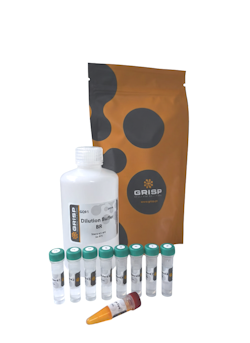
dsDNA Quantification Kit – Broad Range (for microplate reader)

dsDNA Quantification Kits for easy and fast quantification of double-stranded DNA (dsDNA). This broad range (BR) kit was developed for use with microplate readers and is accurate and reliable over a linear range from 4ng to 1000ng.

Add to Quote

Description

GRiSP’s dsDNA Quantification Kits provide an easy and fast method for the quantification of double-stranded DNA (dsDNA). This broad range (BR) kit was developed for use with microplate readers and is accurate and reliable over a linear range from 4ng to 1000ng

GRiSP’s dsDNA Quantification Kits are highly specific for double-stranded DNA. Presence of single-stranded DNA (ssDNA) or RNA does not interfere with the measurements. Other commonly present contaminants in DNA samples, such as proteins, ethanol, phenol, free nucleotides, detergents (SDS, Triton X-100), and salts (NaCl, MgCl2, acetate) also have little to no effect on the fluorescence signal.

Features

Properties
Fast, Accurate and Reliable
Broad Range from 4ng to 1000ng
Highly specific for dsDNA

Documents

Product Info

MSDS ENG

Protocols

  1. Using a clean plastic tube/container, mix for each assay 1 µl of Broad Range Dye with 200 µl of Dilution Buffer (warmed up to room temperature). Do not use a glass container! (e.g. for 96 samples, mix 96 µl Dye with 19.2 ml Buffer).
  2. Pipet 200 µl of the mixture into each well of a microplate suitable for fluorescence-bases assays (not included)
  3. Add 10 µl of each of the 8 dsDNA standards, in duplicate or preferably in triplicate, in separate wells of the microplate and mix by pipetting.
  4. Add 10 µl** of each of DNA sample, in duplicate or triplicate, in separate wells of the microplate and mix by pipetting.
    **Instead of 10 µl, one could add any volume between 1 µl and 20 µl of DNA sample. However, one should adjust for this when determining the initial concentration of the dsDNA in the sample when using the obtained standard curve.
  5. If possible, vortex the microplate using the microplate reader. Before starting measurements, incubate the plate at room temperature for 2 minutes, to get optimal fluorescence. The fluorescence signal is stable for 1 hour after the incubation.
  6. Measure fluorescence using a microplate reader.
    Max Excitation/Emission: 485/545nm whereas Standard Fluorescent Excitation/Emission at ~480/530nm are suitable.
  7. Prepare a calibration curve (standard curve) by plotting fluorescence signals against the corresponding dsDNA standards and drawing a line that best fits the data points (should be a straight line).
  8. dsDNA concentrations of test samples can be determined by direct comparison of the fluorescence signal obtained in the corresponding well with the standard curve. In case of having added another amount than 10µl of sample in step 4, this should be taken into account for the determination of the initial concentration.

Order Information

GQ01.1000 dsDNA Quantification Kit – BroadRange
(for microplate reader)
1000 assays